
Clermont County Resident Lookup Coverage
A Clermont County resident lookup works best as a comparison of official records, not as a search for one master list. Start with the fact already tied to the person. The Clermont County Auditor Real Estate Search can connect an owner to a parcel and may show a tax mailing contact, but an owner is not every resident at that address. The Recorder's CountyFusion index documents a party's recorded land or financial-record role. Court, voter, vital, probate, and state credential sources answer different questions again. Keep the record date, parcel or legal description, and any case or filing number with the result.
| Record | What It Can Confirm | Custodian | Access Route |
|---|---|---|---|
| Auditor parcel record | Owner-to-parcel relationship and possible tax mailing contact | Clermont County Auditor | Public owner, address, or parcel search |
| Recorded instrument | Party role, instrument date, and land-record relationship | Clermont County Recorder | CountyFusion for 1980-present records; counter or mail for earlier material |
| Court docket | Party-to-case relationship and case timeline | Clerk of Courts | Common Pleas or Domestic Relations Case Access, subject to exclusions |
| Registration source | Registration information or a dated county voter dataset | Ohio Secretary of State or Board of Elections | Individual lookup, local tool, or DATA Act file search |
| Vital or probate record | A documented life event, marriage, or estate role | Public Health or Probate Court | Record-specific counter, mail, online, or court route |
| Credential record | Issued professional credential and displayed status | Ohio licensing board | Ohio eLicense verification |
Use the property and Recorder trail when the question is about a documented parcel connection. Use Case Access when a case number, division, or party role can distinguish a same-name result. Use a vital or probate route only to verify the event the custodian keeps. This division of labor keeps a resident lookup grounded in what each Clermont County record actually says.
Matching One Clermont County Resident
Same names are a real Clermont County problem because each index has a different key. Before opening several records, write down full and shortened name forms, a middle name or initial if known, a municipality, a date range, and an address or parcel clue. The Recorder advises name-only or less-information searching for broader results. That can surface variants, but it also makes a second identifier essential. Compare a party's role, recording date, document type, and legal description before connecting a document to a particular person.
Move from an Auditor result to the map or parcel information, then use the name in the Recorder index. A court party match should be narrowed with its division, case number, filing date, or caption rather than assumed to be the same person. An estate record can supply a decedent, fiduciary, heir, beneficiary, or property reference, subject to the court's redactions. The practical rule is simple: a name match begins a Clermont County resident lookup; a matching date, record role, and place make it useful.
Note: A mailing address is correspondence data and may differ from the parcel's situs address, so it does not establish a current household.
Clermont County Court Lookup Limits
Clermont County Case Access links public searches for Common Pleas and Domestic Relations. Common Pleas records before January 1, 1988 are at the Clerk's office, and the online sites do not contain civil domestic-violence petitions. The Clerk also warns that a web record may not yet include every filing, pleading, or decision. Treat an online name hit as an index lead, then ask the court for the appropriate public record when the needed filing or image is absent.
The captured Case Access page is the source for the public-path distinction, not a promise of a fixed set of live result labels. Typical docket results are expected to identify a case number, caption or parties, filed date, case type, docket events, and disposition or status. Confirm the exact live display and obtain the file through the Clerk if the web result is incomplete. The Common Pleas counter is at 270 E. Main St., Batavia. Plain copies cost $0.10 per page and certified copies cost $2 per page.
Here is the public Case Access gateway used to choose the correct court path:
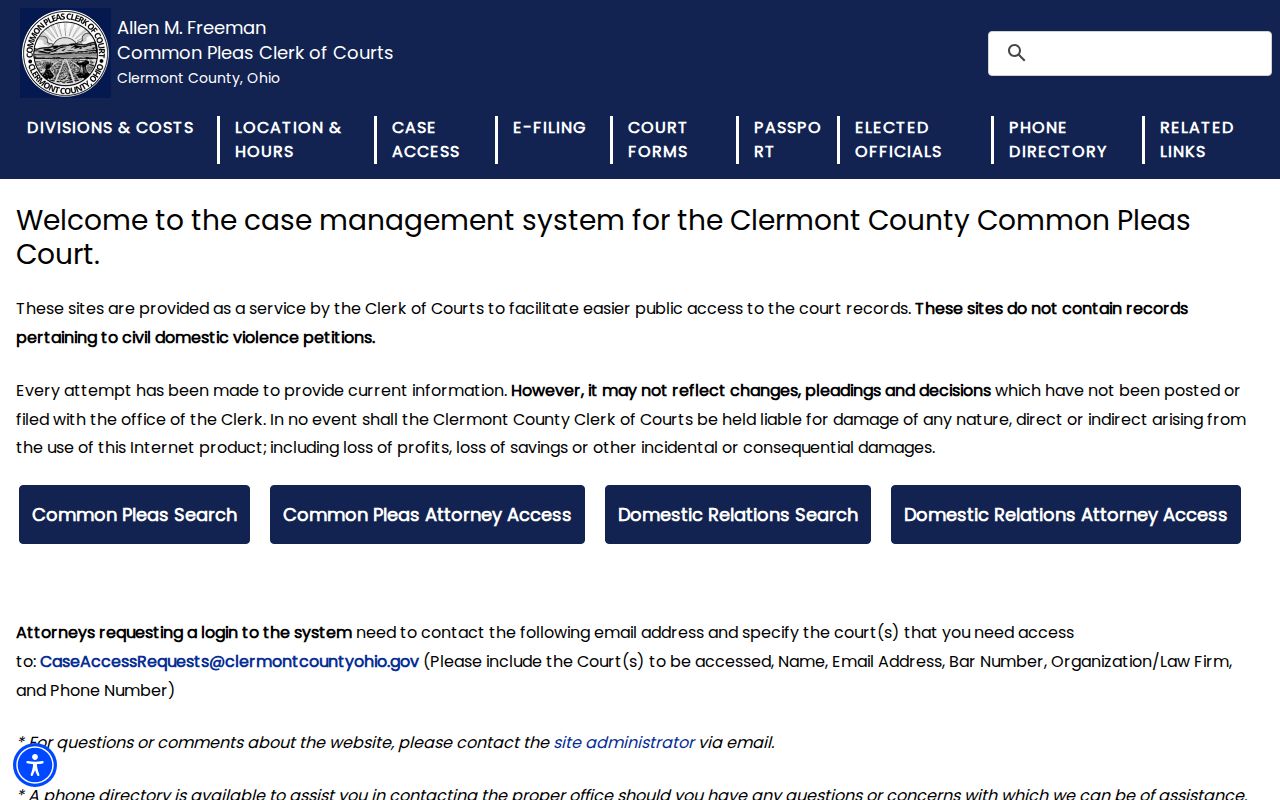
The separate Common Pleas and Domestic Relations links matter because a resident lookup should begin in the division that holds the record, not in a generic court search.
| Expected Docket Detail | Why It Matters |
|---|---|
| Case number and caption | Connects a party name to a particular court matter. |
| Filed date and case type | Helps separate people who share a name. |
| Docket events and status | Shows the case trail, subject to posting delays and exclusions. |
Verify a Clermont County Resident
To verify a Clermont County resident connected to a property, anchor the name first, then compare independent records. This method is useful for a family-history question, an estate matter, or checking a claimed property connection. It does not turn property ownership into proof that every person at an address lives there. Stop when the remaining fact is protected or when the custodian does not maintain it.
- Search the Auditor by owner, address, or parcel and preserve the parcel number, situs address, and displayed owner information.
- Use the parcel or legal description with the Recorder's CountyFusion document search, then record the party role, document type, and recording date.
- Check the appropriate Case Access division for the name, using a case number, date, or division to separate a same-name person.
- For a life event or estate question, ask Public Health or Probate for the record-specific public copy or certified copy that the office allows.
- Docket
- A court's running list of filings, hearings, and case events. It is not always the complete file image.
- Index and image
- An index points to a record. An image is the document copy, which may require a custodian request or be unavailable remotely.
- Certified copy
- A copy the responsible office certifies for the purpose allowed by that office's rules and fees.
Clermont County Vital Record Requests
Vital records are event records, not a general resident directory. Clermont County Public Health Vital Statistics, at 2275 Bauer Road, Suite 300 in Batavia, issues certified copies of Ohio birth certificates and Ohio death certificates within its stated coverage. Birth certificates for births in 1908 or later can be ordered online, by mail, or at the counter. Death certificates filed from 1971 to the present are available by mail or counter, but not online. Each certified birth or death copy is $25; mail orders add $2.50 shipping and handling.
For death certificates created in 2006 or earlier, Public Health asks visitors to call ahead. The local application has record and purchaser fields, and a death certificate containing an SSN has additional eligibility and identification limits. Use the certified-record route rather than a general public-records request for a certificate. Divorce remains a Domestic Relations court-file question, not a Public Health vital-record search.
Clermont Probate Court is the distinct marriage channel. Its county marriage records from 1800 to the present are public. A certified copy costs $3, is available at the counter or by written mail request, and the cited instructions do not state an identification requirement. Probate estate files can also provide an heir or fiduciary lead, but the actual case and any redactions must control.
Clermont County Voter Record Dates
Ohio's My Voter Information is for an individual registration search. Its initial form uses first name, last name, and county, then asks the user to select a street name after narrowing. The state specifically suggests trying a first-name derivative, former last name, or previous Ohio county address after a miss. That is a useful name-variant check, but it does not make the tool a household roster.
For a date-specific research question, the Ohio DATA Act File Search provides Clermont County registration snapshots. The visible controls include election, start date, end date, county list, and download actions. The system permits up to seven days in the interface, and the state retains snapshots for at least 22 months after an election. This is a dated record trail, not evidence of a person's ballot choices. Protected registration fields and addresses remain protected.
Ohio eLicense and Clermont Names
Ohio eLicense is a narrower check within a Clermont County resident lookup. It can verify a named professional credential as the state displays it, including the licensee name, board, license type or number, status, and effective or expiration information where shown. Search by first name, last name, license number, or board, and keep the search date with the result. A credential is an official status check, not proof of residence, identity, household membership, or a complete biography.
The state eLicense landing page below shows the credential-verification route. If a name aligns with a parcel or court record, use the overlapping date, profession, or license number as a second identifier rather than treating the eLicense result as an address record.
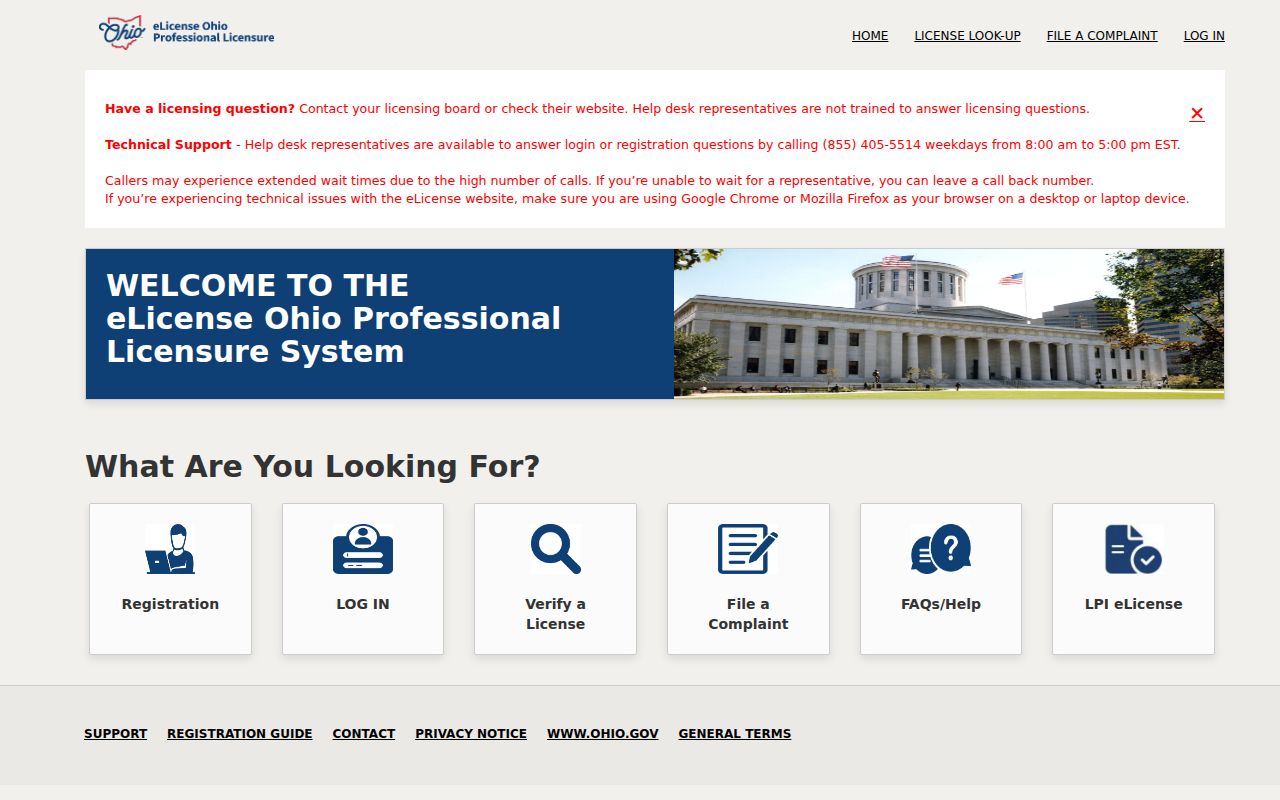
The image supports a credential check only. It should never be used to claim that a licensed person currently lives at a Clermont County address.
Clermont County's 1980 Records Line
When an online index identifies a record but not the needed public copy, ask the office that created it. Ohio's Public Records Act, R.C. 149.43 requires public offices to make public records promptly available for inspection and copies within a reasonable period, subject to exemptions and redaction. A requester can choose paper, the medium the office keeps, or another reasonable duplicating medium. The office may require advance payment for copies, supplies, or delivery.
The request should identify the existing record and requested format. Identity and intended use are not mandatory conditions unless the office first discloses that a written request and disclosure are not required. If an office denies a request, it must explain the legal authority, and a written request receives a written explanation. That route cannot require the county to create a custom resident list or release excluded court, voter, or safety information.
Note: For an older Recorder instrument, the online cutoff is 1980, so use the Recorder's counter or mail-copy route for the documented earlier record.
Clermont County Resident Lookup Limits
A Clermont County resident lookup has deliberate hard stops. Ohio Safe at Home, R.C. 111.41 through 111.47, protects qualifying participants by allowing a state substitute address, and participant identifying information is exempt under R.C. 149.43. Respect a custodian's redaction or substitute address. Do not try to rebuild that protected information from a different record. Courts may also protect juvenile, adoption, sealed, expunged, victim-contact, and domestic-violence material. The Recorder identifies DD-214 military discharges as restricted to authorized people with identification.
Lawful use. Use Clermont County records for personal, lawful research, family history, estate questions, or civic verification. Do not use a resident lookup to stalk, harass, threaten, or expose any person.
For an inaccurate official record, contact its custodian: the Auditor for property data, the Recorder for its recorded-instrument process, the Board of Elections for registration information, the Clerk or Probate Court for court-file procedure, and Public Health for vital-record correction. A result copied from another source does not replace the responsible office's record.