
Clermont County City Directory Shelf
Clermont County has no continuous, countywide city-directory run comparable to that of a large incorporated city. Its historic shelf is deliberately mixed: a county gazetteer, a directory and history, a rural-mail title, a village item, and a township history. That distinction keeps a search honest. The verified titles below establish that a source exists for a defined period or locality, not that each title is a complete resident roll or that every Clermont County address appears in it.
| Collection | Years | Where Held | Access |
|---|---|---|---|
| A. P. Bancroft, Gazetteer & Directory of Clermont County, Ohio | 1882 | Batavia reference / CCGS and Historical Society | Cataloged as R 977.1794 BAN; confirm current use with holder |
| Thirey & Mitchell's Encyclopedic Directory and History of Clermont County, O. | c. 1902 | CCGS / Clermont County Public Library | Cataloged CCGS copy is library use only; a 2002 edition with additions is also cataloged |
| McPherson's Rural Mail Directory of Clermont County, Ohio | 1932-1934 | CCGS / Clermont County Public Library | 1985 reprint cataloged library use only; rural-mail source, not a conventional city directory |
| Bethel Village Directory | 1964 | Clermont County Public Library Sharp Collection | Digital item available through the library collection |
| Goshen Township History and Directory | 2005 | CCGS / Goshen Library | Cataloged library-use-only title from Goshen Township Historical Society |
The discontinuity is useful information, not a defect to paper over. A rural-mail directory answers a different question from a village directory, and a county gazetteer may reach places a municipal book does not. Confirm the title, edition, locality, and access status before treating an absence as evidence. The Batavia collection and Historical Society are the local channels for that shelf check.
Clermont County Directory Milestones
The local sequence has known checkpoints rather than an unbroken annual publication history. Ohio History Connection identifies the 1882 gazetteer as A. P. Bancroft's Batavia work, published by Dale I. Cowen & Co. Later verified titles are separate local publications with their own scope. That is why a careful Clermont County directory search begins by matching a date and locality, then checking the book itself rather than assuming a missing year was never recorded elsewhere.
The Clermont County Historical Society listing for the 1882 gazetteer is the source behind this historical-shelf image.
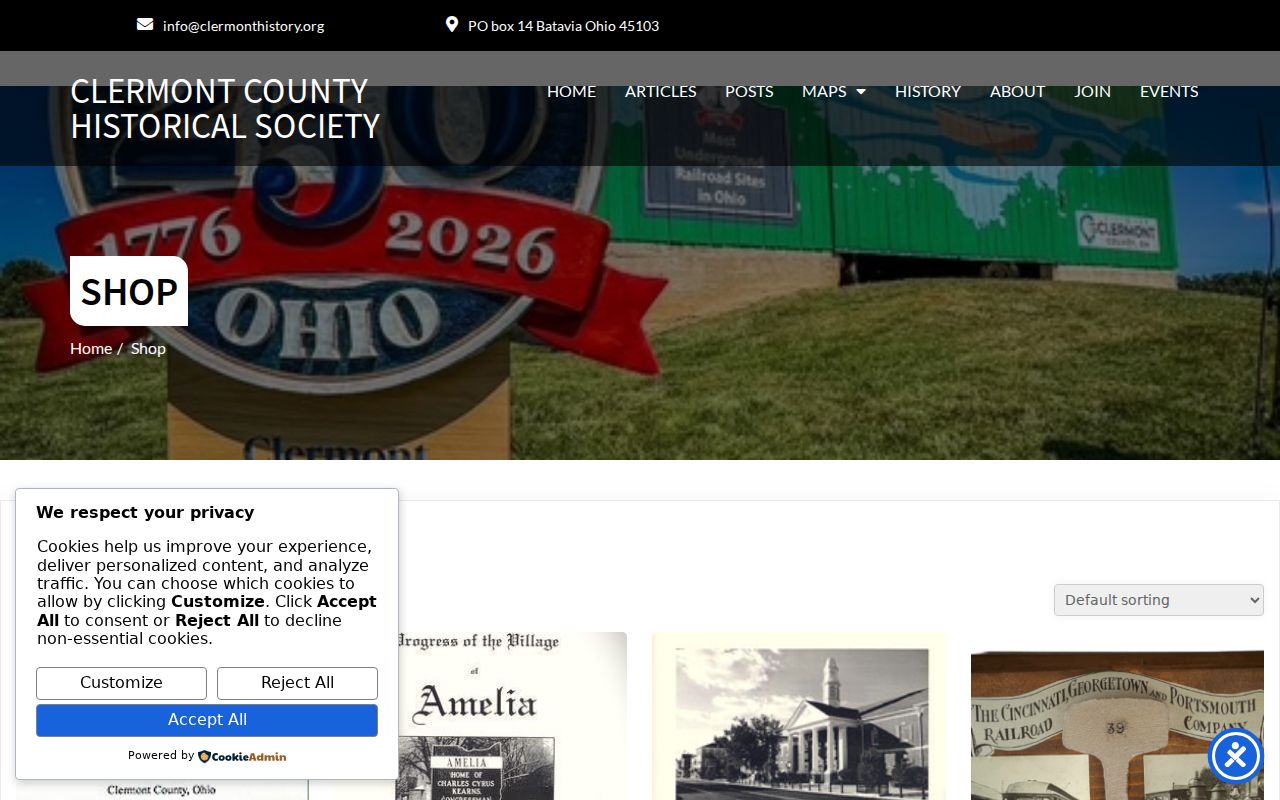
The Historical Society's listed volume is a firm nineteenth-century starting point, while the later titles in the library catalog remain distinct sources that require their own inspection.
- 1882: Bancroft's county gazetteer and directory provides the verified early milestone.
- c. 1902: Thirey & Mitchell's directory and history supplies a later county reference.
- 1932-1934: McPherson's rural-mail directory records a rural service period rather than a standard city run.
- 1964: the Bethel Village item narrows the evidence to a named village.
- 2005: the Goshen Township title is a late, locality-specific directory source.
Batavia's Clermont County Directory Collection
The strongest verified research room for Clermont County directories and companion evidence is the Batavia Branch of Clermont County Public Library, 180 S. Third Street, Batavia, 513-732-2128. It houses the Clermont County Genealogical Society collection and is a FamilySearch affiliate library. CCGS describes specialized county books and indexes, surname files, obituary cards, county newspaper microfilm from 1814 forward, a reader-printer, copier, and computers. Staff accept focused genealogy questions, but the published policy warns that replies depend on capacity and may take time.
The library's genealogy and local-history resources show the access channels surrounding a Clermont County directory search.
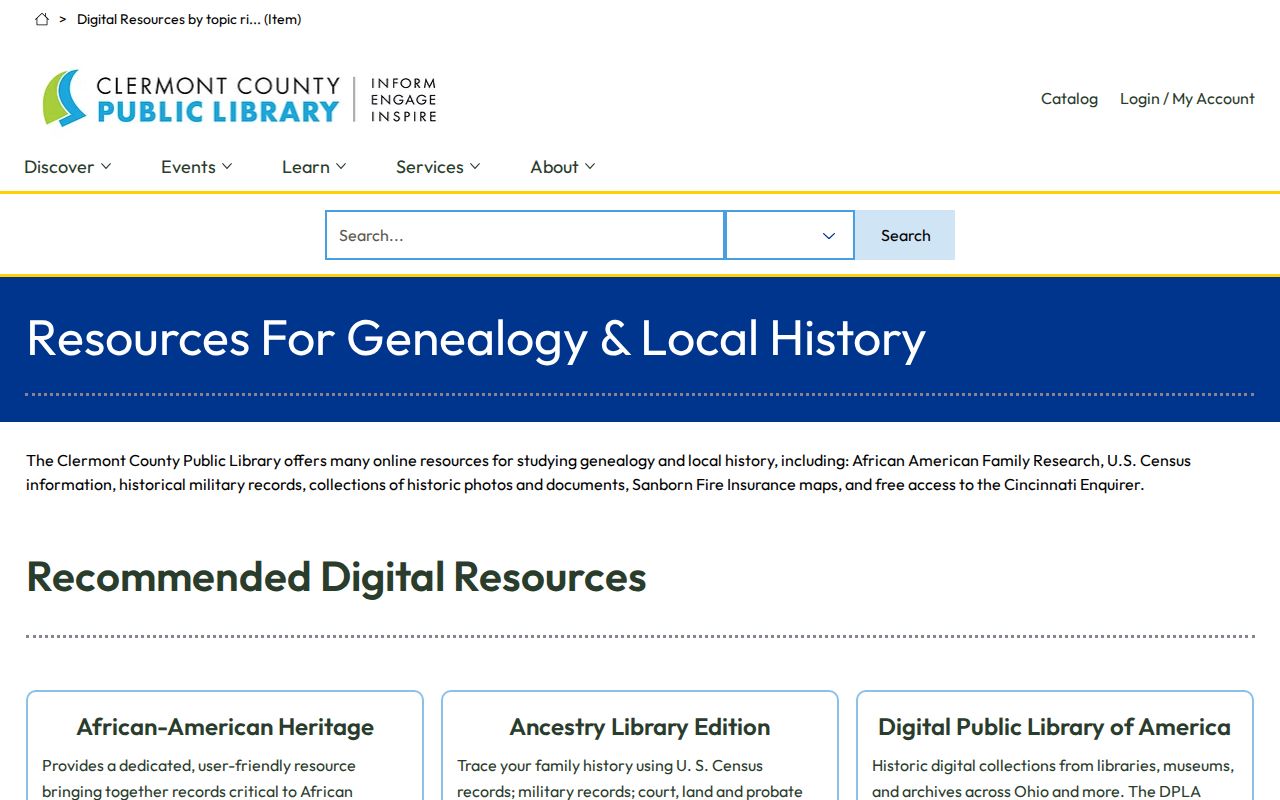
Onsite Ancestry Library Edition, HeritageQuest, FamilySearch affiliate access, newspaper resources, and maps can supply context when the local directory title is too narrow or unscanned.
Access changes with the source. Ancestry Library Edition is onsite, while FamilySearch has free at-home accounts with additional affiliate access at Batavia. HeritageQuest offers family and local histories plus selected census images and indexes. A request should name a particular title, date, township, village, or surname rather than ask staff to reconstruct a whole household from memory.
Note: A library staff query is a capacity-limited research channel, so a title, date range, and locality make a request more practical.
Reading Clermont County City Directory Entries
Available research did not capture a scanned entry page or an abbreviation key for the 1882 gazetteer, the c. 1902 title, McPherson's rural-mail directory, the Bethel item, or the Goshen book. For that reason, a Clermont County city directory entry should not be described with invented fields. Until the actual volume and its key are inspected, only the source's provenance, stated period, and stated locality can be promised. Transcribe only what the opened page actually displays, then cite the edition and page or image reference.
| Source provenance | Record the exact title, edition or reprint, holding institution, and whether the item is physical, cataloged, or digitized. |
|---|---|
| Period | Use the date or date range stated by the collection, without turning it into a claim of continuous coverage. |
| Locality | Keep the book's stated county, village, township, or rural-service scope with every transcription. |
| Visible entry text | Copy only labels, names, places, or marks that are present on the inspected page. |
| Volume key | Check any preface, legend, or abbreviation page before interpreting a symbol or shorthand. |
These terms help describe a historical item without claiming that any listed Clermont County volume contains the feature:
- Criss-cross directory
- A street-ordered directory, if a volume actually includes one, rather than a name-ordered listing.
- Householder index
- An index arranged around household heads only when the volume labels and supplies such an index.
- Abbreviation key
- A printed legend that defines the book's own shorthand and must be read before interpreting a mark.
Clermont County City Directories and Census
A household trail should follow the source that fits its date and locality, not force a family through an unavailable annual series. Pair a directory reference with federal census schedules, which follow the National Archives' 72-year public-release practice, and use the library's census resources for access. Later property evidence belongs in the Auditor and Recorder systems, where an owner or mailing contact still does not establish every person who lived at a place.
- Choose the Bancroft, Thirey & Mitchell, McPherson, Bethel, or Goshen source that matches the known period and locality.
- Inspect the actual entry and transcribe only the fields displayed by that particular item.
- Compare the name or address with the applicable federal census schedule through the library's genealogy resources.
- Use the Clermont County street directory workflow only when a later parcel or legal-description question calls for modern address records.
- Check Probate, Recorder, and an obituary or newspaper item when a marriage, estate, transfer, or name change needs separate proof.
A disappearance from one source is not a conclusion. The source may cover a different locality, use another name form, or omit the household type being sought. Preserve conflicting spellings and dates instead of collapsing them into one unsupported identity.
Clermont County Directory Newspaper Trails
Directory titles gain useful companions at the library. ProQuest Historical Newspapers provides searchable full-page Cincinnati Enquirer coverage from 1841 through 2009, with library-card access from home. CCGS also points researchers to digitized Clermont Sun material from 1852 and Clermont Courier material from 1836 through the county library newspaper archive. An obituary, marriage notice, community item, or address mention can corroborate a period clue, but it remains a separate source rather than a substitute entry.
The Clermont County Library directory-catalog search is the source for the local title listings shown here.
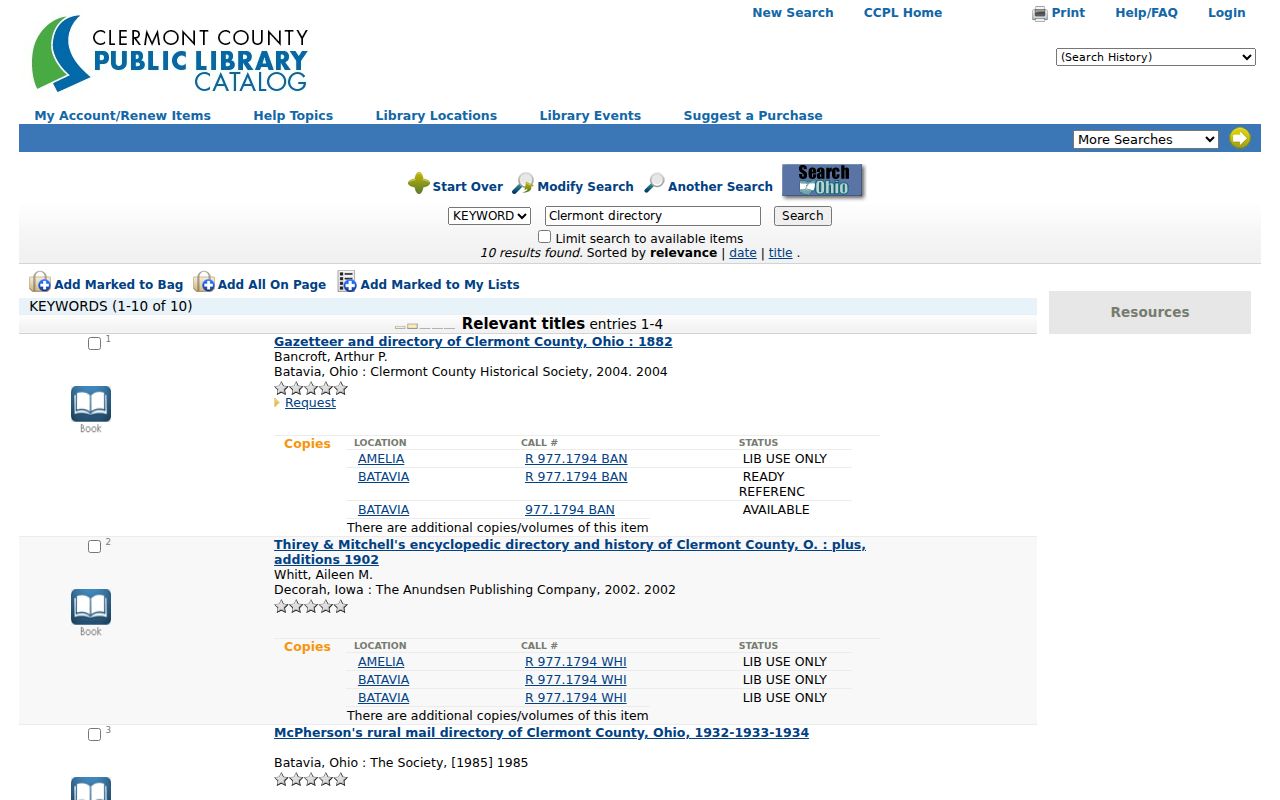
The catalog is a way to confirm that a named Clermont County directory title and call number exist before arranging onsite use or sending a focused question.
Sanborn maps add place evidence instead. The library describes its Sanborn product as large-scale plans from 1867 through 1970, and the Library of Congress has a public-domain 1885 Batavia sheet. Maps can show building and street context; they do not prove occupancy. The Sharp Collection can similarly provide photo or document context without becoming proof that a particular person lived at a location.
Clermont County Records Center Capacity
Clermont County's Records Management Division is a useful preservation lead when a historical directory search turns into a court, land, tax, naturalization, or plat question. Its 2019 climate-controlled building reports 10,000 boxes of paper records, 6,500 historical journals and plat books, and nearly 500,000 electronic records. The Center preserves and images county material, but it does not take ownership from the office that created a record. The originating Recorder, Probate Court, Clerk, Auditor, or another department still controls access.
The Center's research inventory names Chancery records from 1824-1857, Common Pleas journals from 1813-1972, naturalizations from 1811-1929, partition records from 1853-1967, and tax duplicates from 1821-1991. Those are in-person historical record groups, not a promise of a countywide online name index. Ask the likely custodian how to inspect a specified series, and use the library catalog first to identify any printed index.
Note: Central preservation can explain where an older record survives, but the office of origin remains the correct access contact.
Clermont County City Directory Source Limits
Clermont County's record geography prevents a single book from standing in for every city, village, township, and rural route. Postal labels may cross local jurisdictions, and a historical title may describe one place more closely than another. The 1882 gazetteer, c. 1902 directory/history, 1932-1934 rural-mail title, 1964 Bethel item, and 2005 Goshen title are a verified shelf, not a claim of complete coverage between those dates.
For a responsible family-history result, keep the directory title, edition, page or image, locality, and date beside the census, newspaper, map, court, land, or probate citation that supports the next step. The known shelf includes reference, library-use-only, Historical Society, and digital access routes, so availability should be confirmed before a visit or request. That source-by-source approach respects the limits of Clermont County's unscanned historical materials and leaves disputed identity questions open until the underlying record is checked.