
Clermont County Previous Residents by Era
For a Clermont County address, choose the first source by the time period, then move outward only when the source calls for it. The Clermont County Recorder gives the land-document framework. Clermont County library and historical sources add household or place clues. This distinction matters because the research found no verified exhaustive modern reverse-directory shelf for the county. A past name should be tied to a dated document, census schedule, directory entry, notice, or map rather than assumed from a present-day parcel record.
| Source | Years it covers | Where held | What it shows |
|---|---|---|---|
| Recorder online index and images | 1980 to present | CountyFusion | Recorded land-document parties and chain links |
| Recorder books, indexes, and copies | Earlier than 1980 and other physical material | Clermont County Recorder, Batavia | Older deed, plat, and index trail |
| Gazetteer & Directory of Clermont County, Ohio | 1882 | Batavia reference, CCGS, and Historical Society | Historical county name and place reference |
| Federal census | Released after 72 years | NARA and library genealogy databases | Household evidence at the enumeration date |
| Cincinnati Enquirer historical archive | 1841 to 2009 | Clermont County Public Library | Notices and articles, not a complete resident roll |
| Sanborn fire-insurance maps | 1867 to 1970 product range | Clermont County Public Library | Buildings, street plans, and development context |
| Records Center journals and plat books | Dates require custodian confirmation | Records Center and originating office | Historical county administrative and land context |
Start with the online Recorder interval when the date is recent. For earlier Clermont County previous residents, use the physical Recorder route first for the property chain, then add the directory, census, newspaper, and map evidence that fits the period. That keeps a Clermont County previous residents search from becoming a loose collection of names.
Clermont County Address Records Clues
The backward search begins with the current Clermont County parcel record. The Auditor's iasWorld system can be searched by owner, street address, or parcel number. Record the parcel ID, situs address, mailing field when shown, and legal description. The mailing field is a correspondence clue, not proof that someone lived at the property. The legal description is often the lasting identifier when an old house number, road name, rural route, or postal label no longer matches modern usage.
Then open Clermont County General Mapping to see the selected parcel, adjoining geometry, road, and available layers. The Clermont County guide lists address, parcel ID, owner, and road searches, and advises using less text after a miss. In a historical search, that modest tip can expose a road fragment that links a current parcel to an older description.
Batavia Branch's FamilySearch affiliate announcement documents another research channel available after the parcel and time period are clear.
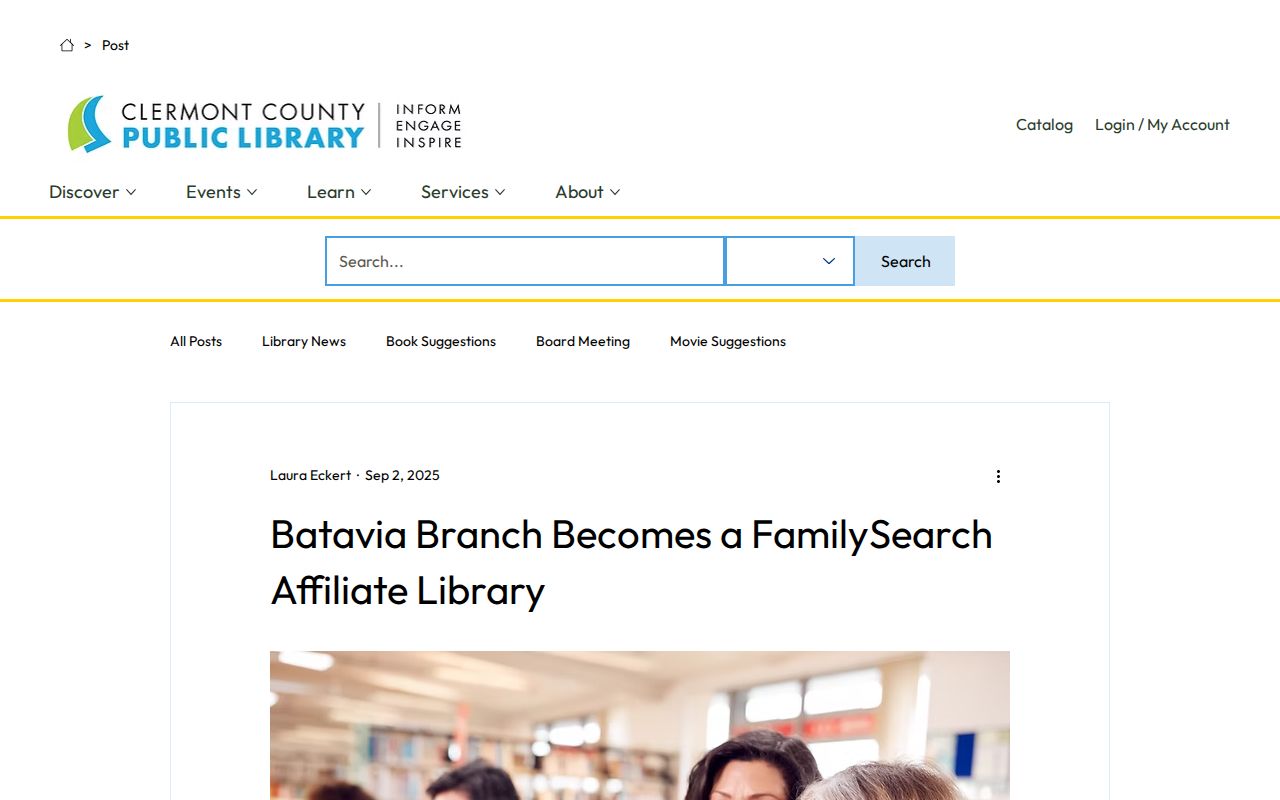
The affiliate location can support a dated Clermont County household inquiry through library-held genealogy resources, without turning property ownership into a claim about every resident.
Tracing Clermont County Past Owners
Recorder instruments connect the property trail. Search the current owner as a grantee in CountyFusion, open the deed, and note its parties, recording date, document number, legal description, and preceding reference. Then search the seller as the earlier grantee. The Recorder's own guidance says a name-only query is most complete and less information returns more possibilities, which is helpful when a party name is abbreviated or indexed differently.
- Find the parcel and legal description in the Auditor record, then retain both alongside the current situs address.
- Search the present owner as a grantee in CountyFusion and inspect the deed or other transfer instrument actually returned.
- Use the prior owner, preceding reference, document number, date, or legal description to find the next older link.
- Repeat with the actual instrument type. A chain can include a certificate of transfer, survivorship deed, quitclaim deed, sheriff's deed, trust, or land contract, not only a warranty deed.
- At the 1980 online boundary, move to the Recorder's counter or mail-copy channel rather than ending the Clermont County trail.
- Grantor and grantee
- The grantor transfers an interest in the instrument; the grantee receives it.
- Chain of title
- The linked sequence of recorded instruments that traces interests in the same land over time.
- Legal description
- The lot, block, metes-and-bounds, or other land description used to identify the property beyond a street address.
Clermont County Previous Residents After 1980
The Recorder's web documents begin in 1980, a useful boundary for a Clermont County address history. The earlier record is not absent just because it is not online. The Recorder keeps older material through its counter and mail channels at 101 E. Main Street in Batavia. The counter is open 8:00 a.m. to 4:30 p.m. and can be reached at 513-732-7236.
Computer prints cost $0.10 per page, staff-pulled book copies cost $0.25 per page, and mail copies cost $2 per page plus a self-addressed stamped envelope. Under the Ohio Public Records Act, R.C. 149.43, the Recorder recommends but does not require its request form. Identify the record and desired format clearly, since an older deed search may require off-site storage or review.
Clermont County Plats and Addresses
A missing address match may be a records-continuity problem, not a missing prior resident. Clermont County's Recorder lists annexation petitions, street-name changes, street and alley vacations, centerline surveys, and plats among its recorded instruments. Compare a historic road name with the legal description and a subdivision lot or block before rejecting a result. For rural acreage, the Recorder directs researchers to tax-map survey plats through the Engineer's Office or Auditor property search.
This is why a deed chain and a household trail must be kept apart. A plat can stabilize the land identity even when the address changed. It does not identify who lived in a building. Likewise, a postal city or ZIP label is not evidence of a municipal boundary, parcel boundary, or past household.
Clermont County Previous Residents in Directories
Use the historical sources as checkpoints for a specific period. The verified local starting point is the 1882 Gazetteer & Directory of Clermont County, Ohio. The library also holds routes to the c.1902 Thirey and Mitchell directory/history, the 1932 to 1934 rural mail directory, the 1964 Bethel Village Directory, and a 2005 Goshen Township directory. These are discontinuous collections, not one continuous Clermont County roll. The fuller collection details belong with the Clermont County city directory collections.
The digitized 1964 Bethel Village Directory record is a concrete local example of a period and place-specific directory.
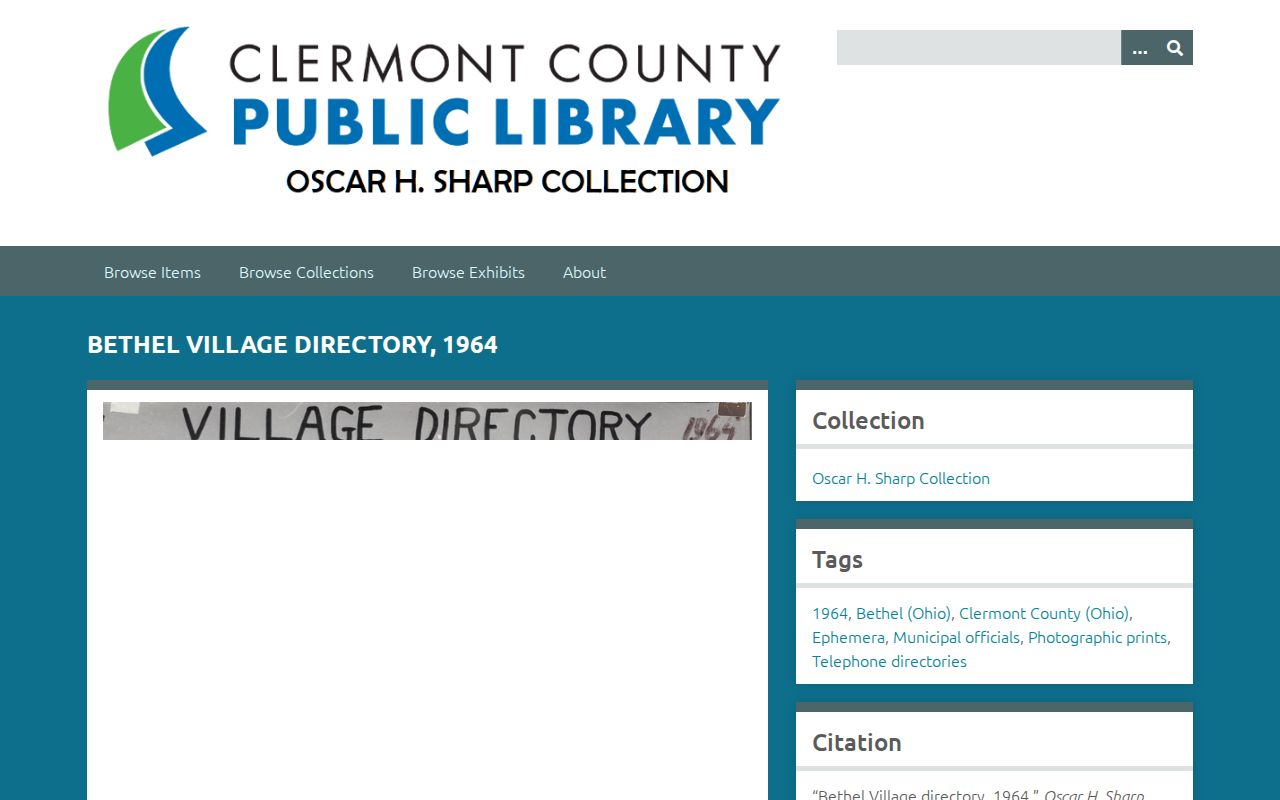
Read a directory entry only for fields actually present in that volume. The research did not capture an authoritative scanned entry key, so exact entry-field and abbreviation claims should not be supplied without checking the item itself.
Pair each dated directory clue with census material released under the federal 72-year rule. Census schedules provide historical household evidence at the enumeration date. The Batavia Branch, through its Genealogical Society Collection, onsite Ancestry Library Edition, HeritageQuest, and FamilySearch affiliate access, provides a local path to compare that evidence.
Clermont County Homes in Enquirer and Sanborn
Newspaper and map sources answer different questions from the deed index. Clermont County Public Library provides access to the Cincinnati Enquirer historical archive from 1841 to 2009, with library-card home access. Search it for an obituary, marriage notice, sale reference, address change, or community mention, then retain the date and page context. It is a strong lead, not a complete resident roll.
CCGS also directs local researchers to digitized Clermont Sun material from 1852 and Clermont Courier material from 1836 through the library newspaper archive. Treat each notice as a dated lead that needs comparison with the property and household trail.
The library's Sanborn product covers 1867 to 1970. Those large-scale maps can show buildings, street plans, and neighborhood development, helping determine whether a structure stood at a place. They cannot prove that a particular person lived there. A careful Clermont County history keeps a map observation separate from a name found in census, directory, or estate material.
Clermont County Records Center Trail
The Records Management Division preserves a large physical and microfilm context for Clermont County records. Its current description reports 10,000 boxes of paper records, 6,500 historical journals and plat books, and nearly half a million electronic records. The facility runs preservation, imaging, and microfilm programs, but it does not replace the office that created a record. Send a request to the Recorder, Clerk, Probate Court, Auditor, or other originating office once the record type is known.
That distinction is useful for a Clermont County house history. A journal, plat book, tax series, court file, or microfilm lead may exist at the Records Center, yet the creating office still controls the request and the access decision. Name the likely series, date range, parcel or legal description, and source question when contacting the originating custodian. The Center is a preservation bridge, not an all-purpose resident search desk.
The Records Center research page identifies preserved historical court, naturalization, partition, and tax series.
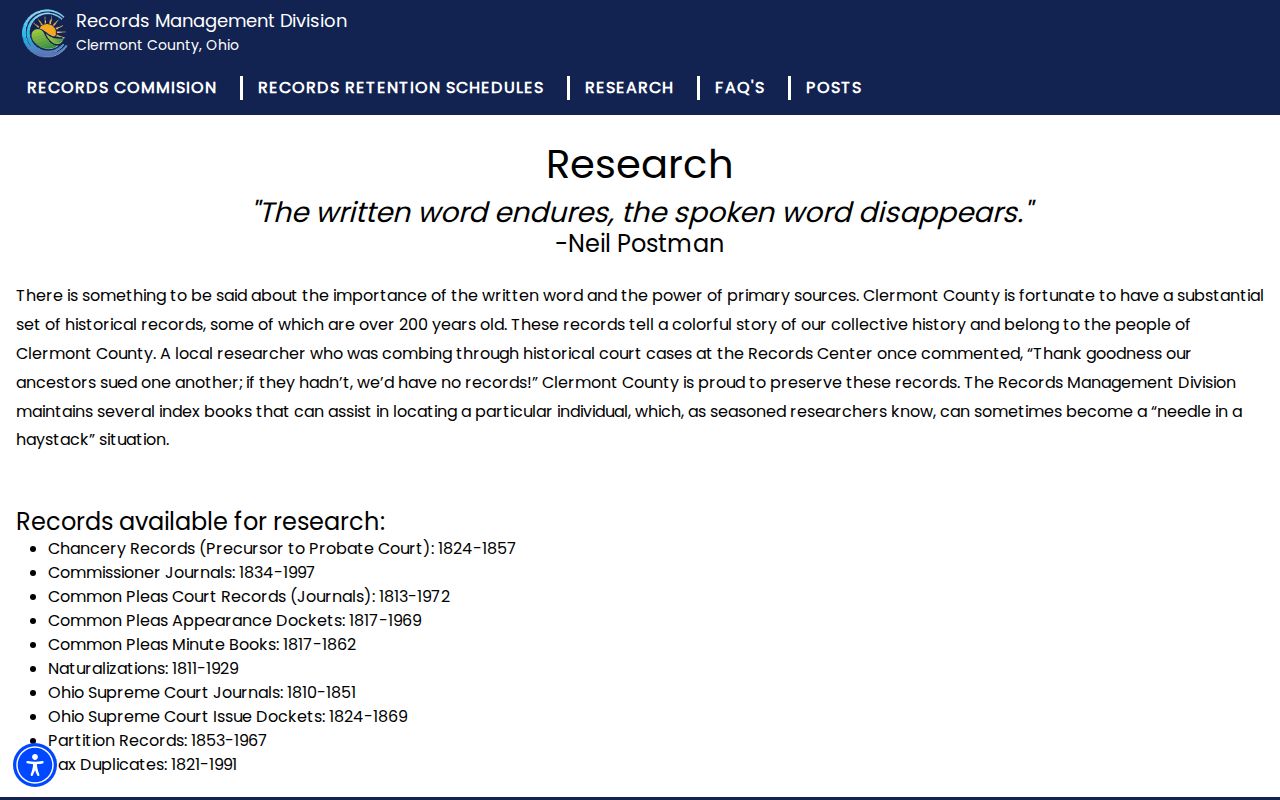
Use the page as a lead to the appropriate Clermont County custodian and confirm dates, access, and copy options there, since the Records Center's listed series do not publish one universal house-history coverage range.
Clermont County Previous Residents Limits
Previous residents research should document a past relationship to a place, not create a dossier about living people. A recorded owner may not have occupied the parcel. A census, directory, newspaper notice, map, probate file, or obituary also has its own date and limits. Safe at Home participant information is exempt under Ohio law, and a public record's redaction or substitute address is a hard stop rather than an invitation to reconstruct the location.
Note: Preserve a citation for each deed, directory item, census schedule, map, and notice so conflicting names and address forms can be checked against the original source.