
Finding Clermont County Residents
Each official record answers a narrow question. No office keeps a master list. An Auditor search ties a recorded owner to a parcel. General Mapping places that parcel among roads and neighboring lots. The Recorder identifies parties to recorded documents. Court, probate, voter, and vital sources handle their own questions. A recorded owner, a mailing contact, and a household are three different things. Keeping those distinctions straight is what makes a Clermont County residents directory search honest.
Begin with the clearest fact you hold. A street address points to the Auditor and GIS. A name tied to property points to the Recorder's index. A family-history question may lead to the library or Probate Court. It may also lead to census material or a newspaper notice. When an online result comes up short, the next stop is usually a counter, a custodian request, or a historical collection rather than another broad name search.
- Search the Clermont County Auditor Real Estate Search by owner, address, or parcel when land is involved.
- Check the parcel and surrounding geography in Clermont General Mapping.
- Use the Recorder’s party index for the deed or other recorded instrument tied to that parcel or name.
- For a dated household question, compare the appropriate library directory, census, newspaper, or probate source.
- Ask the office that created a specific existing record for inspection or copies when its web index ends.
Clermont County Records Offices
Clermont County splits the resident trail across several desks. The Auditor holds the parcel-centered starting point. The Recorder keeps the land instrument trail. The Clerk manages Common Pleas and Domestic Relations files, while Probate handles estates and marriages. Elections and Public Health follow their own legal rules and request paths. For a fuller address sequence, the Clermont County street directory walks through the parcel, map, and document handoff in more detail.
Clermont County Auditor
Real estate and parcel records
Owner, address, and parcel modes
513-732-7150
Ohio and Clermont Elections
Individual registration and county files
Protected information remains withheld
Ask the Board for record help
Clermont County Parcel Starting Points
The Auditor's public iasWorld system searches by owner, address, or parcel. Parcel mode accepts a full or partial Parcel ID. The published instructions even allow an asterisk wildcard. Results can be sorted, limited by page, stored in a Selection Manager, and sent to a Mailing List export. Those controls make a parcel a useful bridge. They still cannot turn a property card into a household roster.
| Clermont search field | Use | Verified note |
|---|---|---|
| Owner | Find property-related records by name | Name-oriented mode |
| Address | Find a situs street address | Property search mode |
| Parcel ID | Find a particular parcel | Full or partial number; * wildcard documented |
| GIS address, owner, road | Locate a map feature | Use less text after a miss |
The Auditor parcel form is the right first screen. Use it once a lot or parcel identifier is known. Read a live property result exactly as displayed. That matters when mailing and situs fields differ.
Note: A current owner or correspondence address is evidence from a property record, not proof of everyone living there.
Clermont County Map Layers
General Mapping adds geography a text result cannot show. It searches by address, parcel ID, owner, or roads. The county training guide offers a simple tip: when an exact search fails, enter less, such as a street number or a partial road name. A returned road or parcel is outlined in red. From there, the popup, layer list, aerial or street basemap, measure, draw, and print controls take the inspection further.
County layers include parcels, addresses, roads, ZIP codes, townships, zoning, and voting precincts. That mix matters here. A postal city name can cross a local boundary. The map can also settle where a parcel sits without ever establishing who lives on it.
Current Clermont County Record Trails
No single Clermont County directory covers every person or address. Each source connects to a person in one defined way: ownership, a party role on a recorded document, voter registration information, a court case, or a stated life event. Combining those sources carefully beats treating one result as a complete profile. One record is a clue, not a biography.
| Record source | Connection shown | Custodian | Access route |
|---|---|---|---|
| Auditor parcel record | Owner and parcel context | County Auditor | Public owner/address/parcel search |
| Recorded instrument | Party role and recording date | County Recorder | CountyFusion, counter, or mail |
| Voter information | Registration information or dated county file | Ohio SOS / Board | Individual lookup or DATA archive |
| Court or probate file | Party, case, estate, or marriage matter | Clerk / Probate Court | Portal or custodian access |
| Historic collections | Period-specific household clues | Library / CCGS | Collection, inquiry, or onsite resource |
An official Clermont County record and a commercial people-finder product do different work. The official record keeps its custodian, date, and stated limits. A commercial compilation may be convenient. Yet it can hold stale or mixed information. Nothing replaces checking the Clermont County source record itself.
| Clermont County official record | Shows the limited fact its custodian maintains, with an inspection or copy route. |
|---|---|
| Commercial compilation | May combine older data but does not replace a current Clermont County custodian record. |
Verifying one named person? Add a second identifier. A parcel, record date, municipality, or party role separates people who share a name, and the Clermont County resident lookup follows that method without confusing land title with residence.
Clermont County Voter Dates
Ohio's individual voter lookup lets a voter find registration information. Clermont also offers VoterView. It requires first name, last name, and full date of birth, with an optional suffix. The Ohio DATA Act File Search works differently. It delivers a county voter-registration snapshot as it existed on a chosen day. Filters include election, start date, end date, and county list. The public interface allows a one-to-seven-day range. Custom packages can be queued by email, and download links expire after 72 hours.
The state retains each daily snapshot. It keeps them at least 22 months after an election. Voter history is not a record of candidate choices. It shows participation, not how anyone voted. Protected fields and Safe at Home information stay outside any lawful search.
Clermont County Court Boundaries
Clermont County keeps its court records split across two doors. The Clerk’s Case Access page reflects that split. Common Pleas and Domestic Relations each get their own search. Case records from before January 1, 1988 live only at the Clerk’s office. Civil domestic-violence petitions stay off the online sites entirely. A match online can still give you a case number. It may also show the parties, a filing date, and a docket trail. Treat it as a pointer, though. It may lag behind new filings, and it is never the complete file.
Vital and probate records run through different channels in Clermont County. Clermont Public Health issues qualifying Ohio birth and death certificates. Probate Court, meanwhile, holds public county marriage records reaching back to 1800. That separation matters for anyone tracing family through the residents directory era. A marriage record, a court docket, and a certificate each answer a different question. Each can carry its own copy procedure too. Probate Court’s marriage route survives as a documented historical channel. It is not a general name list.
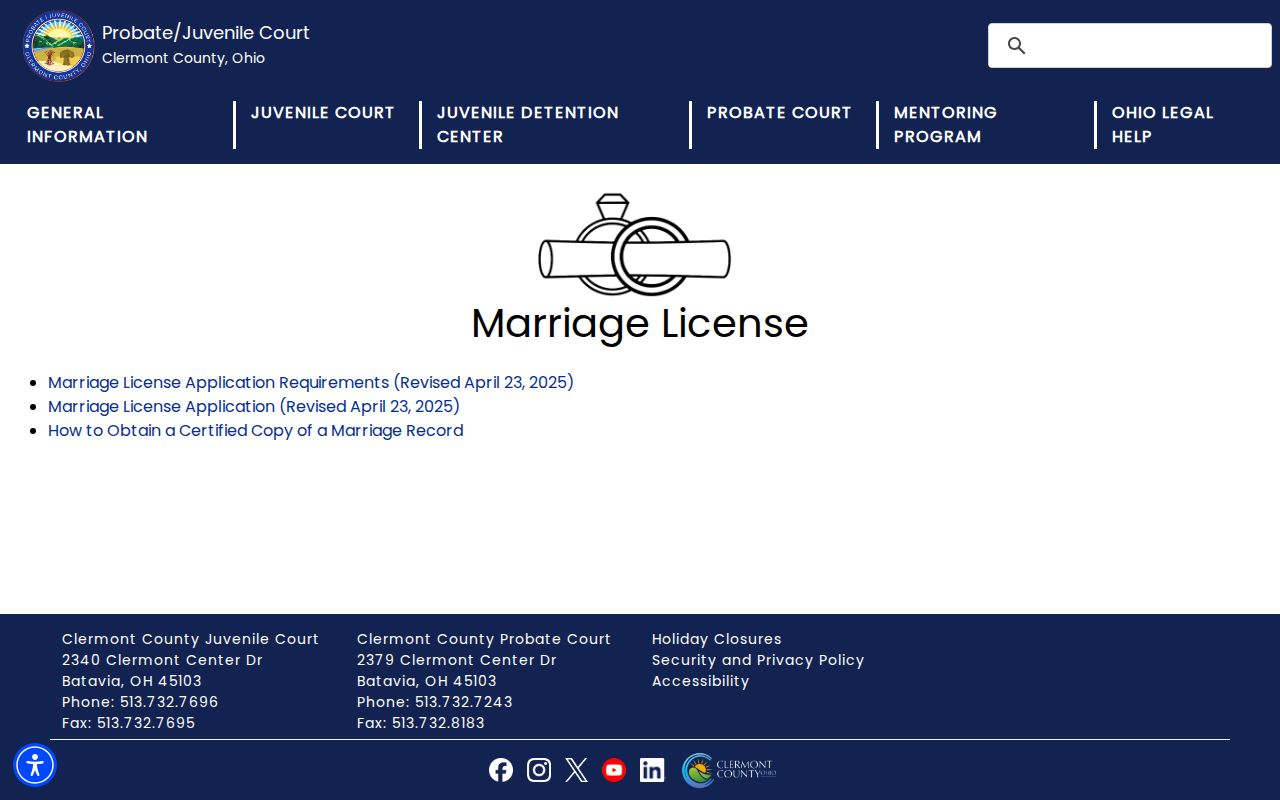
The page illustrates the separate Probate channel for marriage records and certified-copy instructions.
Clermont County Certificate Routes
Clermont Public Health runs a local Vital Statistics office. It issues Ohio birth and death certificates. Its rules differ by record type. Online birth orders are limited to people born in 1908 or later. Death certificates cannot be ordered online at all. Each certified birth or death copy carries a $25 charge. Mail, counter, and specified online channels depend on the record. The current request form adds a $2.50 shipping and handling fee per mail order.
Older death records get extra care. For a certificate created in 2006 or earlier, the office asks visitors to call ahead. A version containing an SSN is restricted to listed authorized classes with identification. Those are record-specific access rules. No name search in a residents directory can imply them. The Clermont Public Health vital-record instructions lay out the local ordering channels.
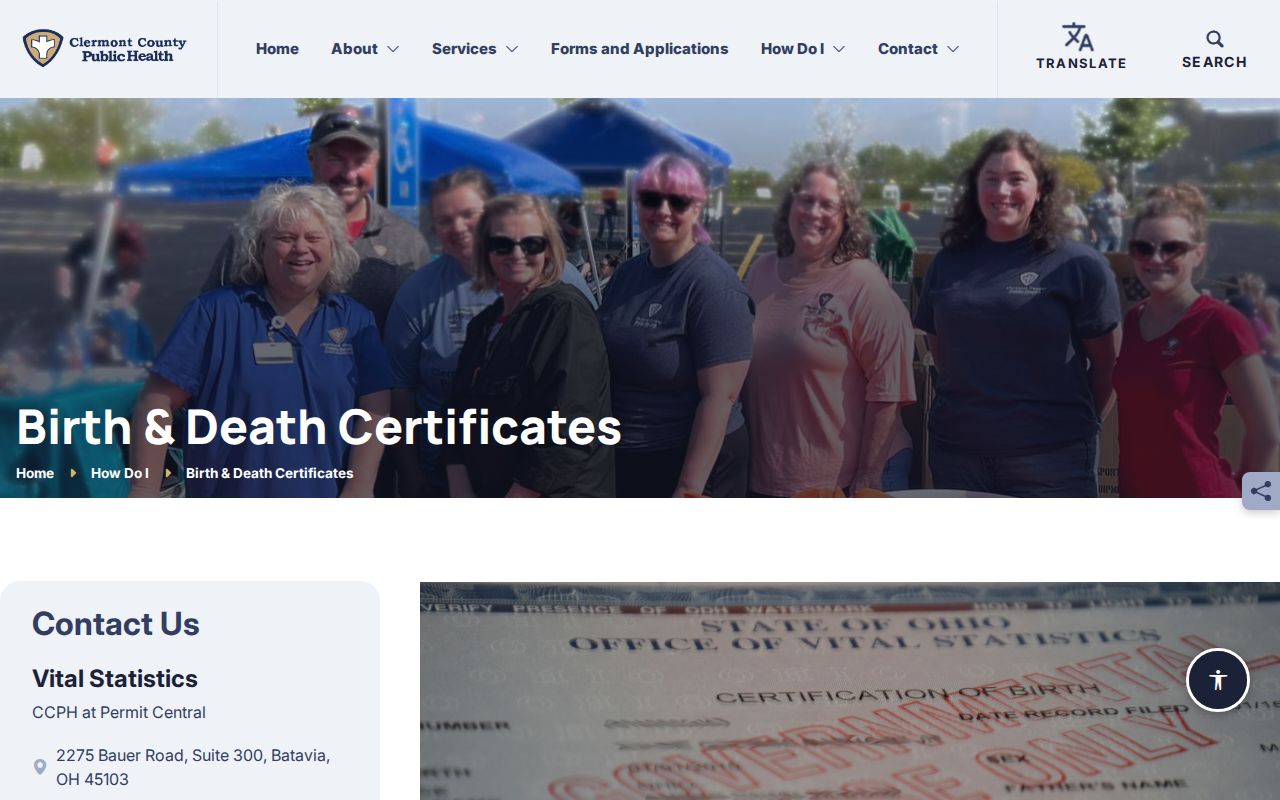
The custodian’s application keeps a life-event record distinct from an address record.
Clermont County Recorder History
The Recorder’s web search covers documents recorded from 1980 to the present. That cutoff is a number worth knowing. Earlier material was never discarded. It remains available at the counter or through written mail-copy requests. The office records deeds, mortgages, liens, plats, and annexation petitions. It also handles street-name changes. Street and alley vacations are recorded there too. Those instruments often explain why a modern address fails to match an older description. The mismatch can matter. A parcel trail in the Clermont County residents directory era may hinge on it.
Build a property trail the practical way. Start with the current owner or the legal description, then search recorded parties and the instrument details. Once you hit the web cutoff, shift to the counter. A written request works too. Copies run $0.10 per page from the computer. Staff-pulled book copies cost $0.25 per page. Mail copies cost $2.00 per page plus a self-addressed stamped envelope.
Clermont County FraudSleuth Alerts
FraudSleuth is the Recorder’s no-cost notification service. It flags a document recorded against a configured name. The Recorder’s FAQ offers one key tip. Set up separate profiles for each form of the name. That means the full middle name, the middle initial, and any nicknames. An alert is a prompt, not a verdict. Inspect the actual recorded instrument, then contact the Recorder or a qualified adviser if something looks wrong. The service never decides a filing is fraudulent.
This option beats generic monitoring pitches for a simple reason. It is tied to Clermont County’s own Recorder and its recorded-document process. It can also help a property owner spot a questionable solicitation charging for a record the custodian already provides.
Clermont County Historic Directories
Historical searching in Clermont County starts on a discontinuous shelf. There is no single continuous city-directory run. The verified local anchor is A. P. Bancroft’s Gazetteer & Directory of Clermont County, Ohio, published in 1882. The library and CCGS also catalog a c. 1902 Thirey & Mitchell directory and history. Add a 1932 to 1934 rural mail directory, a 1964 Bethel Village Directory, and a 2005 Goshen Township history and directory. Each volume catches the county at one moment.
Read every entry in the context of its period and locality. Past residents listed in one directory may vanish from the next, and that gap is not an error. The full collection and access discussion sits on the Clermont County city directory page. Pair a historical entry with census records, a newspaper notice, a probate matter, or a recorded land trail. Never assume one listing establishes a whole household.
- Parcel
- A county property identifier that bridges mapping and land records.
- Index
- A finding aid that points to a document or entry, not necessarily the document image itself.
- Resident roll
- A record set with a particular purpose and coverage, not a universal population list.
- Criss-cross directory
- An address-oriented directory format; no comprehensive Clermont run was verified in the research.
Clermont County Library Evidence
The Batavia Branch of Clermont County Public Library holds the Clermont County Genealogical Society Collection. It also serves as a FamilySearch affiliate library. Onsite resources include Ancestry Library Edition, HeritageQuest, and historical Cincinnati Enquirer access. Sanborn maps and a staff genealogy-query route round out the offerings. The Enquirer archive spans 1841 through 2009. The Sanborn product covers 1867 through 1970.
Each resource carries a different kind of evidence. A census schedule can place a household at an enumeration date. A newspaper supplies a dated notice. A map shows a building or street layout at one point in time. Neighbors and past residents emerge. They do so only when these sources are read together. None should be pushed to prove more than its source supports.
Clermont County Records Center
The Clermont County Records Center explains why so much old material sits outside any portal. Its holdings include 10,000 paper boxes. There are also 6,500 historical journals and plat books and close to 500,000 electronic records, plus microfilm and imaging work. More than 40 county offices store records there. Even so, the office that created a record stays its custodian and controls access.
The Center's inventory lists Chancery records from 1824 to 1857. It also holds Common Pleas journals from 1813 to 1972, naturalizations from 1811 to 1929, partition records from 1853 to 1967, and tax duplicates from 1821 to 1991. Those ranges point to where a historic lead might exist. A Clermont County residents directory search could start there. They do not promise a free web name index.
Clermont County Request Rights
Ohio's Public Records Act, R.C. 149.43, sets the ground rules. Public offices must make records promptly available for inspection. Copies must arrive within a reasonable period. A requester picks paper, the medium the office already keeps, or another reasonable duplicating medium. Offices may ask for advance payment covering copies, supplies, or delivery.
The law opens a route to records that exist. It does not force an office to build a list it never kept. A focused request names the record, the date range, and the format. That alone speeds things up. If any part of a request is denied, the office must cite its legal authority, and a written request earns a written explanation.
Clermont County Privacy Limits
Public records have edges. Ohio Safe at Home gives qualifying participants a substitute address. Their identifying information is exempt from disclosure. Voter files, court records, adoptions, juvenile matters, sealed or expunged cases, and DMV data each carry separate protections. A redaction or substitute address is a hard stop. It is not a puzzle to solve through other sources.
Lawful use. Use Clermont County records for personal, civic, family-history, estate, property, or consumer-safety questions, and never to stalk, harass, intimidate, or harm another person.
Ohio My Voter Information is one official source, and it keeps its person-level search deliberately narrow.
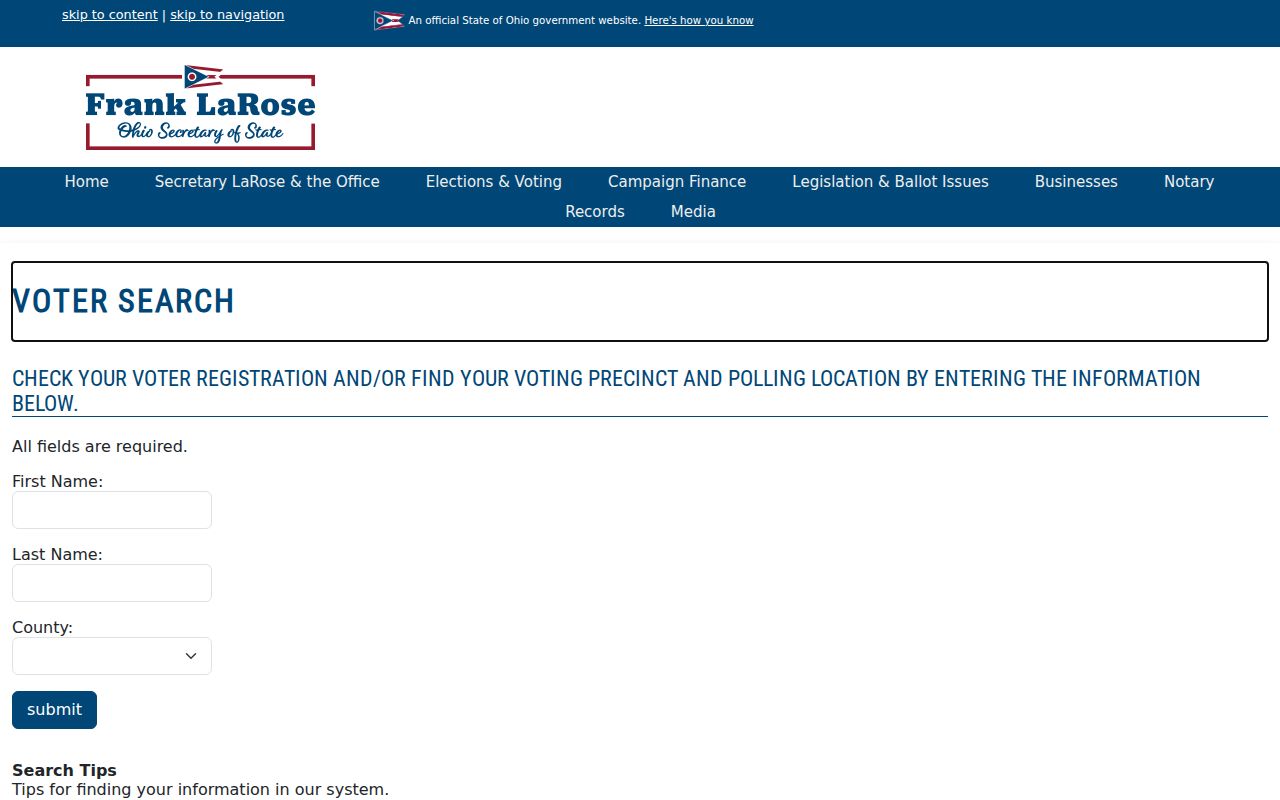
That individual voter interface exists for registration information, while date-specific county files travel a separate public-record route.
Clermont County Parcel Search
The Auditor's parcel search earns its spot as an opening move. It ties an address or an owner name to the county's wider property framework. That framework is the layer behind most Clermont County residents directory lookups. General Mapping can then confirm the physical parcel. The Recorder documents a party's land-record relationship. The next record should match the actual question. That matters especially where a mailing address, business, trust, or estate appears in the property record.
The public Auditor parcel search shows the starting controls used in the county system.
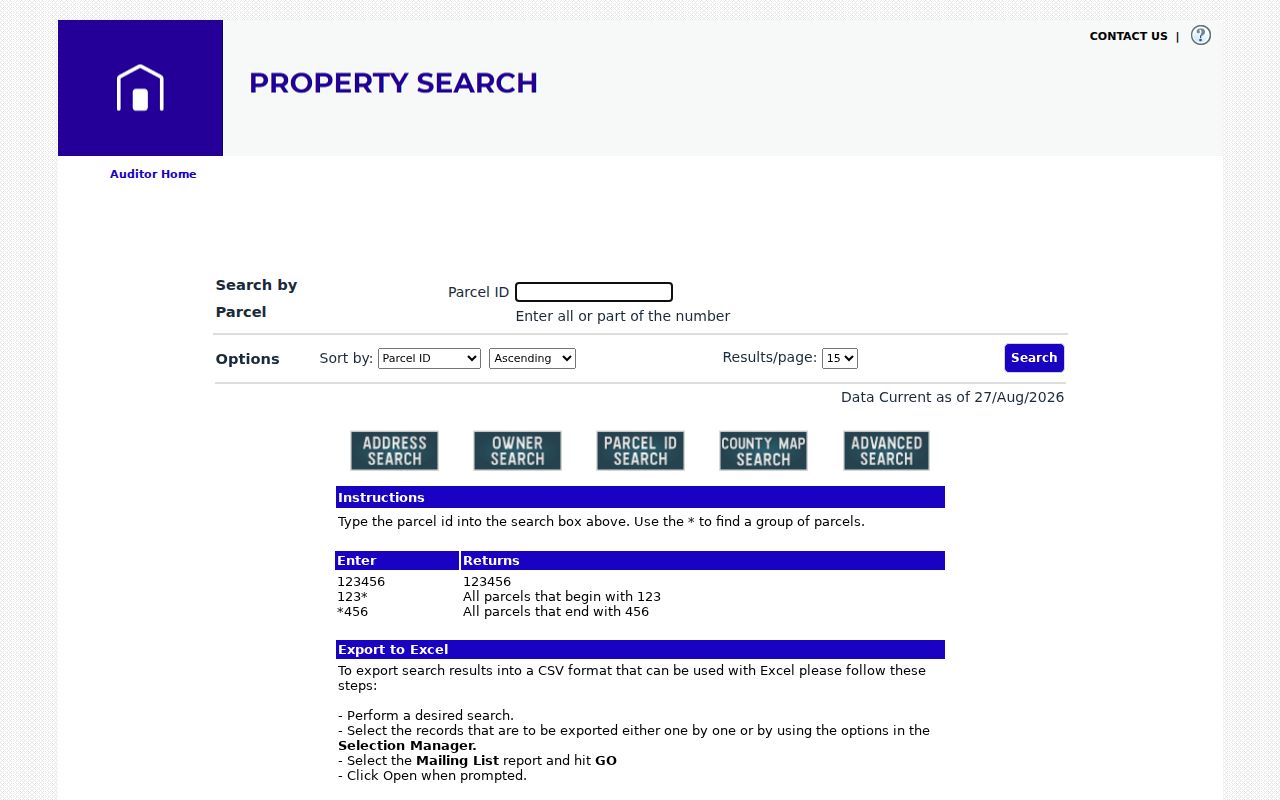
The search controls support parcel-oriented research before results are weighed against mapping and recorded instruments.