
Finding Clermont County Residents
Use an official record as a narrow answer, not as a master list. An Auditor search can connect a recorded owner to a parcel. General Mapping can place that parcel among roads and nearby lots. The Recorder can then identify parties to documents, while court, probate, voter, and vital sources answer separate questions. A recorded owner, mailing contact, and household are not interchangeable. That distinction keeps a Clermont County residents directory search grounded in what each custodian actually keeps.
Begin with the clearest fact in hand. A current street address favors the Auditor and GIS. A name with a property connection favors the Recorder’s index. A family-history question may require the library, Probate Court, census material, or a newspaper notice. When an online result is incomplete, the next channel is often a counter, a custodian request, or a historical collection rather than another broad name search.
- Search the Clermont County Auditor Real Estate Search by owner, address, or parcel when land is involved.
- Check the parcel and surrounding geography in Clermont General Mapping.
- Use the Recorder’s party index for the deed or other recorded instrument tied to that parcel or name.
- For a dated household question, compare the appropriate library directory, census, newspaper, or probate source.
- Ask the office that created a specific existing record for inspection or copies when its web index ends.
Clermont County Records Offices
Clermont County keeps different parts of the resident trail at different desks. The Auditor supplies the parcel-centered starting point. The Recorder holds the land instrument trail. The Clerk holds Common Pleas and Domestic Relations files, and Probate handles estate and marriage matters. Elections and Public Health have their own legal rules and request paths. For a full address sequence, the Clermont County street directory explains the parcel, map, and document handoff in more detail.
Clermont County Auditor
Real estate and parcel records
Owner, address, and parcel modes
513-732-7150
Ohio and Clermont Elections
Individual registration and county files
Protected information remains withheld
Ask the Board for record help
Clermont County Parcel Starting Points
The Auditor’s public iasWorld system offers owner, address, and parcel routes. In parcel mode, a full or partial Parcel ID is accepted and the published instructions allow an asterisk wildcard. Results can be sorted, limited by results per page, placed in a Selection Manager, and taken to a Mailing List export. Those controls make a parcel a useful bridge, but they do not turn a property card into a household roster.
| Clermont search field | Use | Verified note |
|---|---|---|
| Owner | Find property-related records by name | Name-oriented mode |
| Address | Find a situs street address | Property search mode |
| Parcel ID | Find a particular parcel | Full or partial number; * wildcard documented |
| GIS address, owner, road | Locate a map feature | Use less text after a miss |
The Auditor parcel form is the right first screen when a lot or parcel identifier is known. A live property result should be read as the system displays it, especially when mailing and situs fields differ.
Note: A current owner or correspondence address is evidence from a property record, not proof of every person who lives at the location.
Clermont County Map Layers
General Mapping adds the geography that a text result cannot show. It searches address, parcel ID, owner, and roads. The county training guide says a failed exact search often improves when the user enters less, such as a street number or partial road name. A returned road or parcel is outlined in red; the popup, layer list, aerial or street basemap, measure, draw, and print controls provide the next level of inspection.
The available county layers include parcels, addresses, roads, ZIP codes, townships, zoning, and voting precincts. That mix is especially useful in a county where a postal city name can cross a local boundary. It also explains why a map can identify a parcel’s setting without establishing a current household at the parcel.
Current Clermont County Record Trails
No single Clermont County directory covers every person or address. Each source has a defined connection to a person: ownership, a recorded party role, voter registration information, a court case, or a stated life event. Combining those sources carefully is more reliable than treating one result as a complete profile.
| Record source | Connection shown | Custodian | Access route |
|---|---|---|---|
| Auditor parcel record | Owner and parcel context | County Auditor | Public owner/address/parcel search |
| Recorded instrument | Party role and recording date | County Recorder | CountyFusion, counter, or mail |
| Voter information | Registration information or dated county file | Ohio SOS / Board | Individual lookup or DATA archive |
| Court or probate file | Party, case, estate, or marriage matter | Clerk / Probate Court | Portal or custodian access |
| Historic collections | Period-specific household clues | Library / CCGS | Collection, inquiry, or onsite resource |
A Clermont County official source and a commercial people-finder product do different work. The official record preserves its custodian, date, and stated limits. A commercial compilation may be convenient, but it can retain stale or mixed information and is not a substitute for checking the Clermont County source record.
| Clermont County official record | Shows the limited fact its custodian maintains, with an inspection or copy route. |
|---|---|
| Commercial compilation | May combine older data but does not replace a current Clermont County custodian record. |
When the task is to verify one named person, use a second identifier such as a parcel, record date, municipality, or party role. The Clermont County resident lookup follows that name-centered method without confusing land title with residence.
Clermont County Voter Dates
Ohio’s individual voter lookup helps a voter find registration information. Clermont also has VoterView, with required first name, last name, and month, day, and year of birth fields, plus an optional suffix. For historical county-level research, the Ohio DATA Act File Search is different: it delivers a county voter-registration snapshot as it existed on a selected day.
DATA Act filters include election, start date, end date, and county list. The public interface allows a one-to-seven-day range; its described custom packages can be queued by email, and download links expire after 72 hours. The state says it retains the daily snapshots for at least 22 months after an election. Voter history is not a record of candidate or issue choices, and protected fields and Safe at Home information remain outside a lawful search.
Clermont County Court Boundaries
The Clerk’s Case Access page separates Common Pleas and Domestic Relations searches. Common Pleas records before January 1, 1988 are at the Clerk’s office, and civil domestic-violence petitions are excluded from the online sites. An online case match can point to a case number, parties, date, and docket trail, but it may lag filings and is not a complete file.
Vital and probate records follow their own channels. Clermont Public Health issues qualifying Ohio birth and death certificates, while Probate maintains public county marriage records from 1800 forward. That separation matters for family research: a marriage record, a court docket, and a certificate answer different questions and can have different copy procedures.
Probate Court’s marriage route is shown below because it is a documented historical channel, not a general name list.
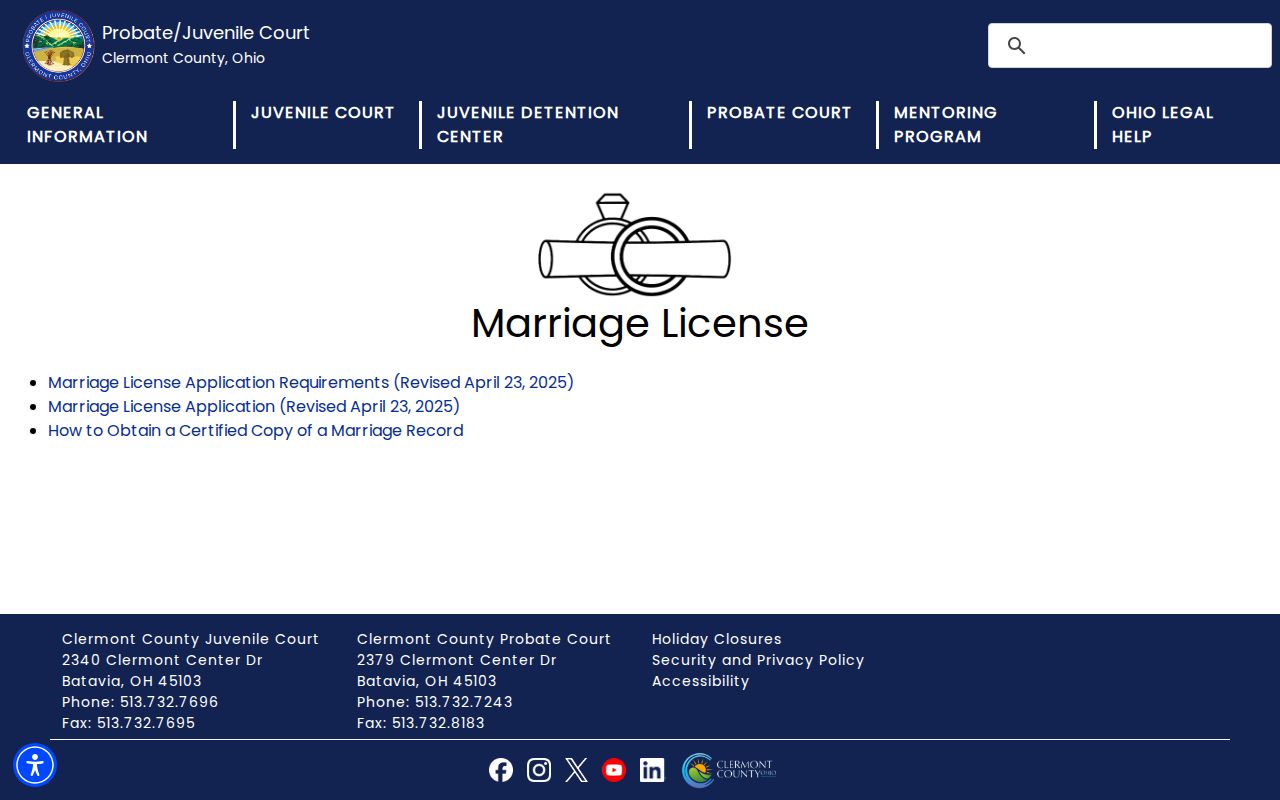
The page illustrates the separate Probate channel for marriage records and certified-copy instructions.
Clermont County Certificate Routes
Clermont Public Health’s Vital Statistics office is a local issuer for Ohio birth and death certificates. The office says online birth orders are limited to people born in 1908 or later, while death certificates cannot be ordered online. It states a $25 charge for each certified birth or death copy, with mail, counter, and specified online channels depending on record type. The current request form also describes a $2.50 shipping and handling charge per mail order.
For a death certificate created in 2006 or earlier, the office asks visitors to call ahead. A version containing an SSN is restricted to listed authorized classes with identification. These are record-specific access rules, not facts that can be inferred from a name search.
Clermont Public Health vital-record instructions show the local ordering channels.
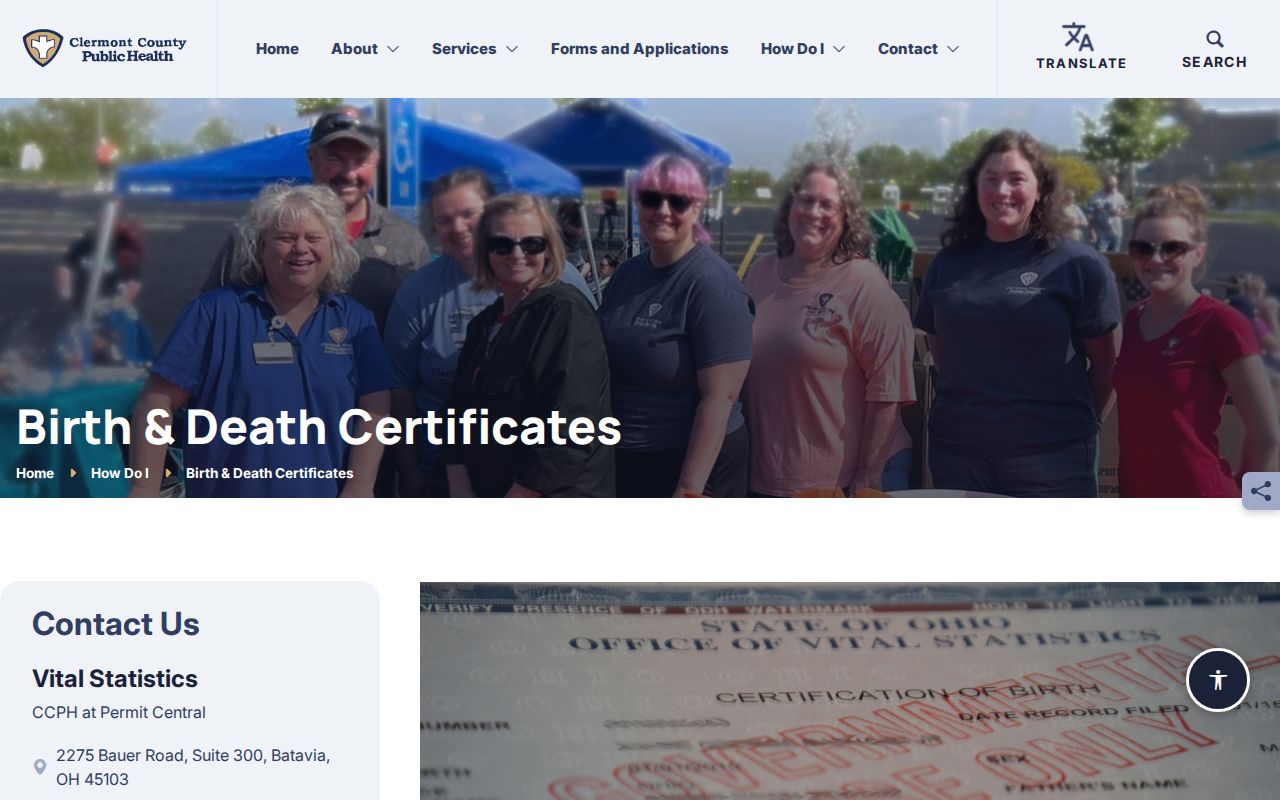
Using the custodian’s application avoids confusing a certified life-event record with a current address record.
Clermont County Recorder History
The Recorder’s online boundary is a useful number for a historical search: documents recorded from 1980 to the present are available through its web search. Earlier material was not discarded. It remains available through the Recorder’s counter and written mail-copy routes. The office records deeds, mortgages, liens, plats, annexation petitions, street-name changes, street and alley vacations, and other instruments that can explain why a modern address does not match an older description.
For a property trail, start with the current owner or legal description, then search recorded parties and the actual instrument details. At the web cutoff, shift to the counter or a written request rather than stopping the record trail. The stated counter copy charges are $0.10 per page from the computer and $0.25 per page when staff pull a book; mail copies are $2.00 per page plus a self-addressed stamped envelope.
Clermont County FraudSleuth Alerts
FraudSleuth is the Recorder’s no-cost notification service for a document recorded against a configured name. The Recorder’s current FAQ advises separate profiles for each form of a name, including a full middle name, middle initial, and nicknames. An alert is a prompt to inspect the actual recorded instrument and contact the Recorder or a qualified adviser if something appears wrong. It does not decide that a filing is fraudulent.
This localized alert option is more useful than a generic monitoring pitch because it is tied to Clermont’s Recorder and its recorded-document process. It can also help a property owner recognize a questionable solicitation that charges for a record or service available from the custodian.
Clermont County Historic Directories
Historical searching in Clermont County begins with a discontinuous shelf, not one continuous city-directory run. The verified local starting point is A. P. Bancroft’s Gazetteer & Directory of Clermont County, Ohio, published in 1882. The library and CCGS also catalog a c. 1902 Thirey & Mitchell directory/history, a 1932 to 1934 rural mail directory, a 1964 Bethel Village Directory, and a 2005 Goshen Township history and directory.
Those volumes need to be read in the context of their period and locality. The full collection and access discussion belongs on the Clermont County city directory page. Pair a historical entry with census, a newspaper notice, a probate matter, or a recorded land trail instead of assuming it establishes a whole household.
- Parcel
- A county property identifier that bridges mapping and land records.
- Index
- A finding aid that points to a document or entry, not necessarily the document image itself.
- Resident roll
- A record set with a particular purpose and coverage, not a universal population list.
- Criss-cross directory
- An address-oriented directory format; no comprehensive Clermont run was verified in the research.
Clermont County Library Evidence
The Batavia Branch of Clermont County Public Library houses the Clermont County Genealogical Society Collection and serves as a FamilySearch affiliate library. Its local resources include onsite Ancestry Library Edition, HeritageQuest, historical Cincinnati Enquirer access, Sanborn maps, and a staff genealogy-query route. The Library’s Enquirer archive covers 1841 through 2009, while its Sanborn product covers 1867 through 1970.
For historic research, those resources carry different kinds of evidence. A census schedule can identify a household at an enumeration date, a newspaper can supply a dated notice, and a map can show a building or street layout. None should be made to prove more than its source supports.
Clermont County Records Center
Clermont’s Records Management Division helps explain why older material may survive beyond a portal. It reports 10,000 paper boxes, 6,500 historical journals and plat books, and nearly 500,000 electronic records, along with microfilm and imaging work. The Center preserves records for more than 40 county offices, but the office that created a record remains the custodian that controls access.
Its research inventory names Chancery records from 1824 to 1857, Common Pleas journals from 1813 to 1972, naturalizations from 1811 to 1929, partition records from 1853 to 1967, and tax duplicates from 1821 to 1991. These ranges show where a historic lead might exist, not a promise of a free web name index.
Clermont County Request Rights
Ohio’s Public Records Act, R.C. 149.43, requires public offices to make public records promptly available for inspection and provide copies within a reasonable period. A requester can choose paper, the medium already kept by the office, or another reasonable duplicating medium. Offices may seek advance payment for copies, supplies, or delivery.
The law is a route to existing public records, not an instruction to create a list that the office does not keep. A well-focused request names the record, date range, and desired format. If an office denies part or all of a request, it must explain the legal authority, and a written request receives a written explanation.
Clermont County Privacy Limits
Public records have boundaries. Ohio Safe at Home protects qualifying participants through a substitute address program, and participant identifying information is exempt from disclosure. Voter, court, adoption, juvenile, sealed, expunged, and DMV information can have separate protections. A redaction or substitute address is a hard stop, not a puzzle to solve through other sources.
Lawful use. Use Clermont County records for personal, civic, family-history, estate, property, or consumer-safety questions, and never to stalk, harass, intimidate, or harm another person.
Ohio My Voter Information is one official source that makes its limited person-level search clear.
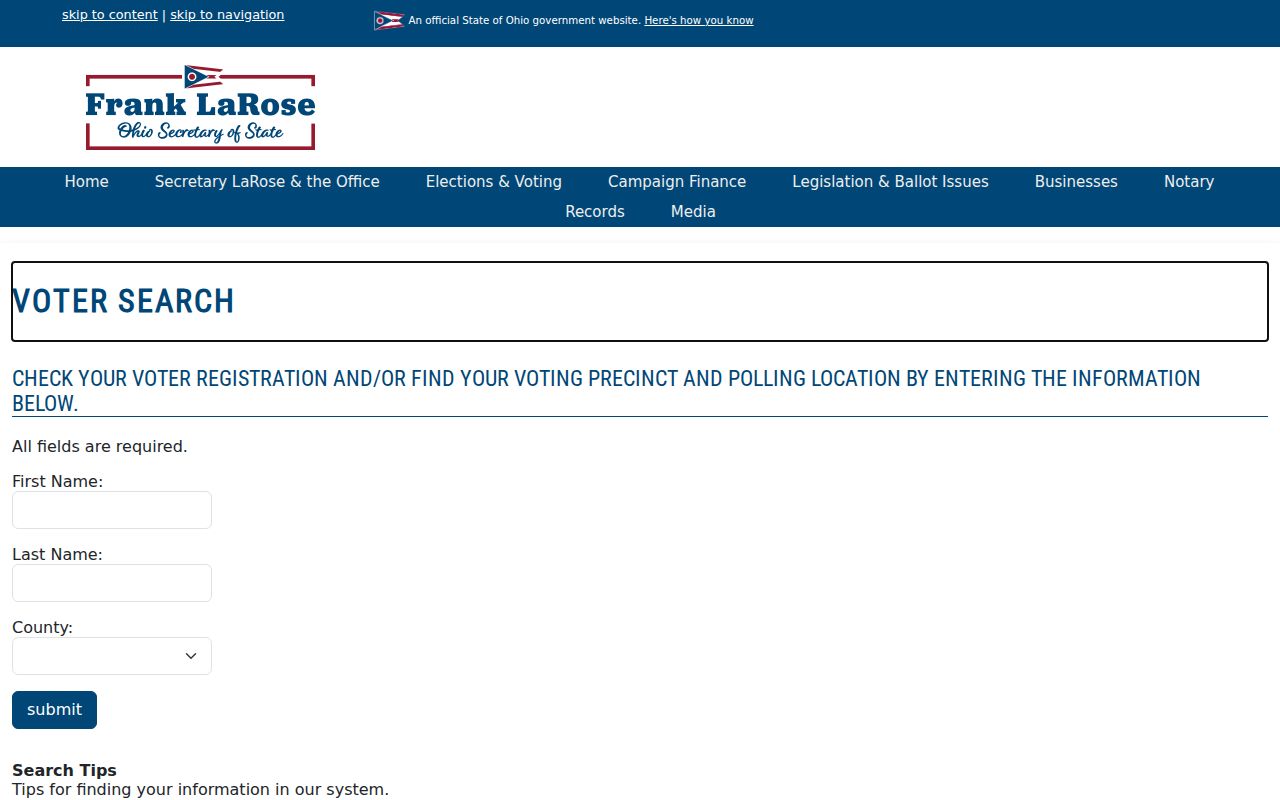
The individual voter interface is designed for registration information, while date-specific county files follow a different public-record route.
Clermont County Parcel Search
The Auditor’s parcel search is an effective opening move because it connects an address or owner name to the county’s property framework. From there, General Mapping can confirm the physical parcel and the Recorder can document a party’s land-record relationship. The next record should always match the question, especially when a mailing address, a business, a trust, or an estate appears in the property record.
The public Auditor parcel search displays the starting controls documented in the county system.
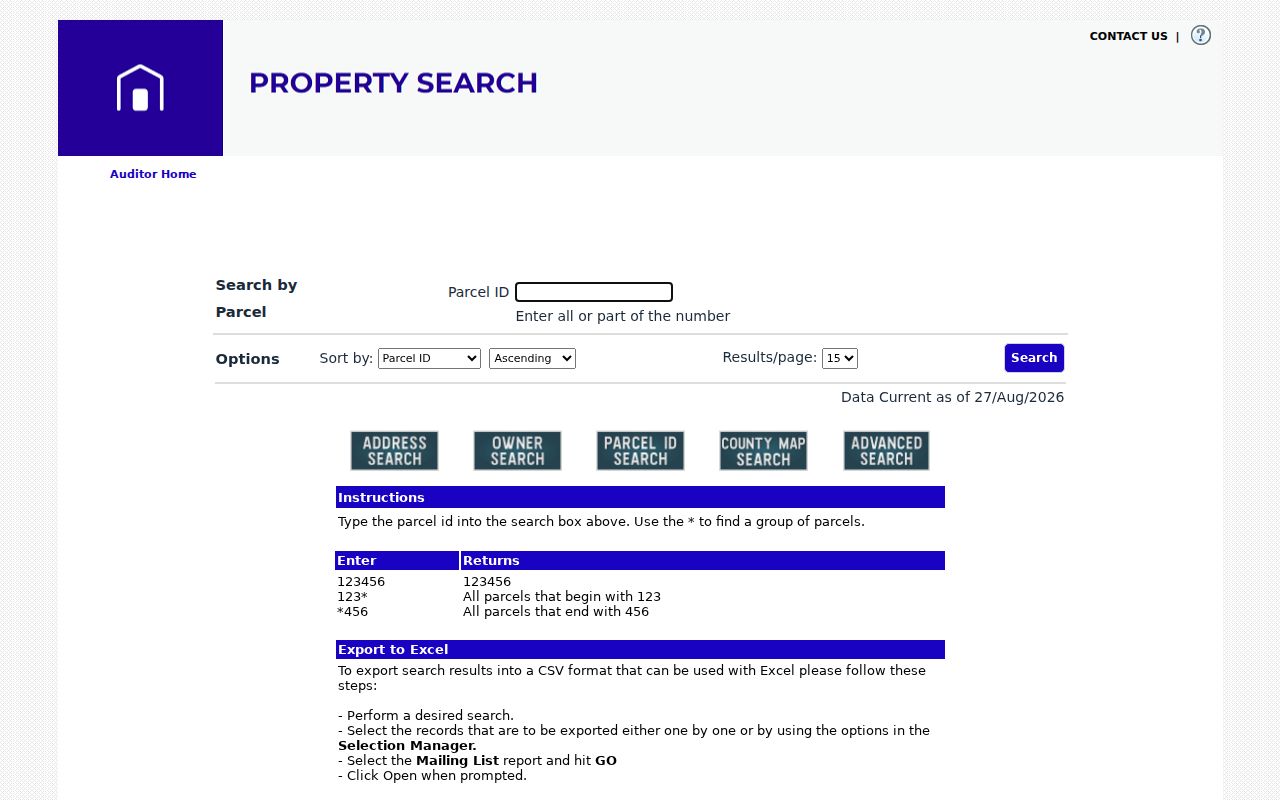
The search controls support parcel-oriented research before the result is compared with mapping and recorded instruments.